
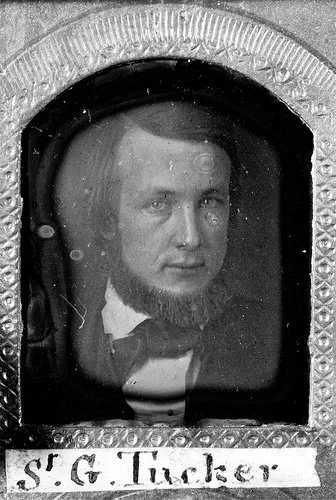

St. George Tucker was an American lawyer, teacher, soldier, and writer connected to the Confederate South during the American Civil War. He was born in 1828 in Virginia and died in 1863 while still a relatively young man. Tucker belonged to a well-known Virginia political family. His father, Henry St. George Tucker, served as a legislator, congressman, and judge in the early years of the United States. Growing up in this environment placed Tucker close to the legal and political culture of Virginia. His work as a writer and poet developed alongside a career in law and education, and his literary output reflects the Southern political and social climate of the mid-nineteenth century. (Ashland Museum)
Before the Civil War, Tucker worked as a lawyer and became involved in Virginia’s state government. During the 1850s he served as clerk of both the Virginia Senate and the House of Delegates. At the same time he pursued educational work. In 1857 he founded the Ashland Male Academy, a classical school for boys in the town of Ashland, Virginia. Tucker eventually left his position as clerk to devote his attention to the school and to writing. His literary work during this period included poetry, fiction, and songs. Among his known works are a novel titled Hansford: A Tale of Bacon’s Rebellion, later republished as The Devoted Bride, and several poems and lyrics reflecting the history and culture of Virginia. (Ashland Museum)
The outbreak of the American Civil War brought a major shift in Tucker’s life. When fighting began in 1861 he closed the Ashland Male Academy and helped organize a company of soldiers known as the Ashland Grays. The unit trained locally before becoming part of the Fifteenth Virginia Regiment of Volunteers in the Confederate army. Tucker took an active role in leading the company and gained a reputation as a determined officer who remained close to his men in the field. (Ashland Museum)
During the war he continued to serve despite serious illness. Tucker had contracted tuberculosis, commonly referred to at the time as consumption, but he remained with his regiment. His leadership during the Peninsula Campaign earned particular notice. At the Battle of Malvern Hill in 1862 he led his troops in action despite his worsening condition. For his conduct in the field he was promoted to lieutenant colonel of the regiment. The promotion recognized his ability as a commander and the respect he had gained among Confederate soldiers under his command. (Ashland Museum)
Tucker’s health continued to decline as the war progressed. The illness that he had carried through the campaign eventually forced him away from active military service. He died in 1863 before the end of the war. His early death cut short both his military career and his literary work. (Ashland Museum)
Alongside his service as an officer, Tucker remained active as a writer. One of his best-known pieces was the song “The Southern Cross,” which circulated widely during the Civil War and became associated with Confederate patriotic culture. His poetry and songs reflected the political loyalties of the Confederate South and were part of a larger body of wartime writing that combined literature, propaganda, and morale building. Within the broader tradition of nineteenth-century American poetry, his work fits into the patriotic and regional writing that developed around the Civil War. (Ashland Museum)
St. George Tucker’s legacy rests on three areas of activity: education, literature, and military service. As a teacher he helped establish one of the early schools in Ashland. As a writer he produced poetry, fiction, and songs tied closely to Southern identity during the Civil War. As a soldier he organized and led a local company that became part of the Confederate army and rose to the rank of lieutenant colonel. His life reflects the way many educated Southerners of his generation moved between intellectual work and military leadership during the conflict. His surviving writings, especially the wartime song “The Southern Cross,” remain the main record of his contribution to Civil War–era literature.
“The Southern Cross.”
St. George Tucker II
Oh! say can you see, through the gloom and the storm,
More bright for the darkness, that pure constellation?
Like the symbol of love and redemption its form,